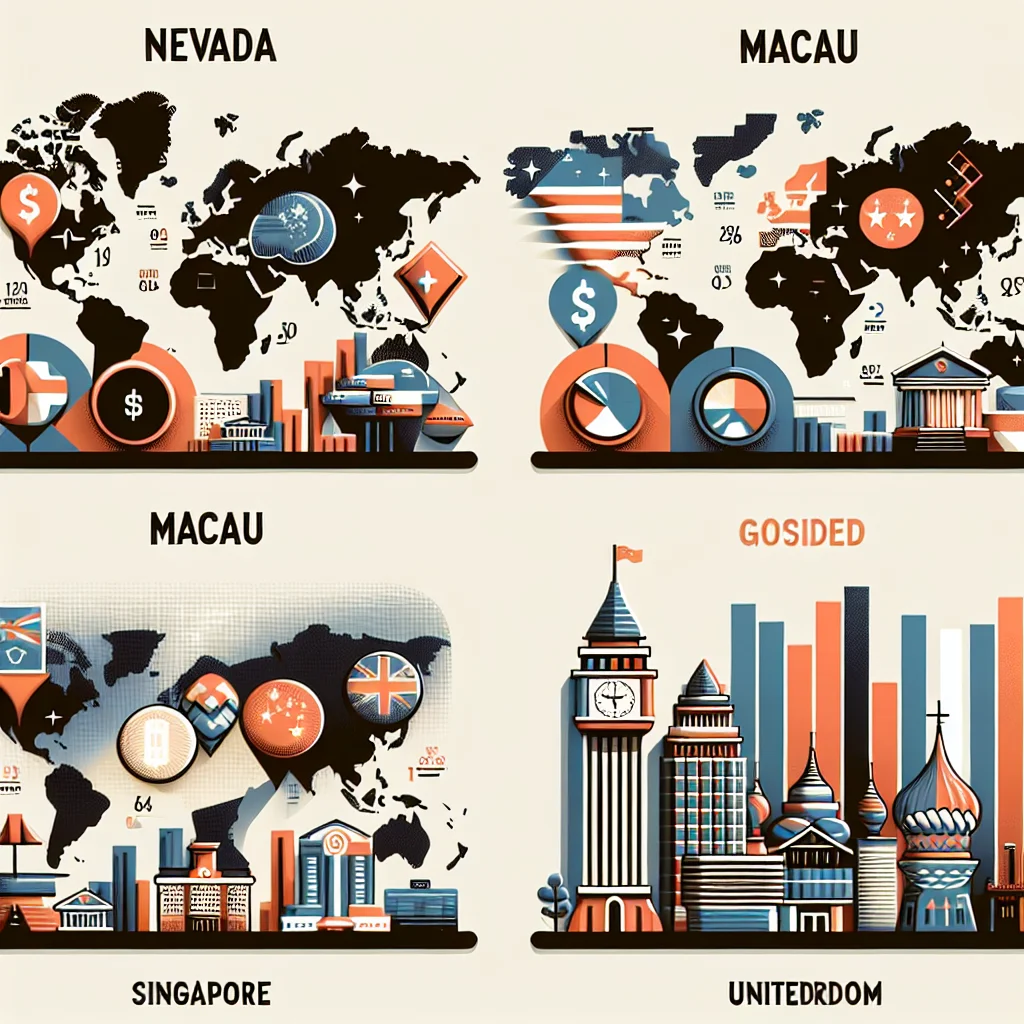
A World of Chance: Contrasting Models of Casino Regulation
The global casino industry is not a monolith; it is a patchwork of distinct markets shaped by local culture, law, and economic policy. Understanding these regional differences is key to grasping the industry’s worldwide footprint. The United States presents a fragmented model, where regulation is primarily a state issue. Nevada, with Las Vegas as its epicenter, operates on a principle of liberal accessibility, with casinos integrated into the fabric of the city. Conversely, New Jersey’s Atlantic City was historically developed as a tourism driver for a struggling economy. The newer markets of Pennsylvania and Michigan represent a more modern, revenue-focused approach where casinos are taxed heavily as a source of state budget funding. Across the Atlantic, the United Kingdom employs a national licensing framework through the Gambling Commission, emphasizing consumer protection and anti-money laundering protocols. Meanwhile, the Asian powerhouse of Macau operates under a unique concession system, where a handful of operators are granted government licenses, creating an oligopoly focused overwhelmingly on the VIP baccarat segment. Each regulatory model directly influences market size, operator profitability, and the type of customer experience offered.
Macau vs. Las Vegas: A Tale of Two Gambling Capitals
The economic narratives of Las Vegas and Macau offer a fascinating study in contrasts. Las Vegas has successfully executed a long-term diversification strategy. While gaming revenue remains crucial, it now accounts for less than half of the total revenue for major Strip operators. The city has reinvented itself as a comprehensive entertainment destination, with world-class dining, shopping, nightlife, and conventions driving growth. This model provides resilience; when gaming win dips, other segments can buoy the economy. Macau, a Special Administrative Region of China, presents a different picture. It is the undisputed gambling capital of the world by revenue, dwarfing Las Vegas many times over. Its economy is overwhelmingly dependent on casino taxes, which fund a vast portion of government services. However, this creates vulnerability. Macau’s model has been historically tied to the VIP junket system, catering to high-rollers from mainland China. Political crackdowns on capital outflow and anti-corruption campaigns in China can cause severe volatility in Macau’s revenues. While Macau is now pushing for its own diversification with more family-oriented attractions, its economic identity remains deeply intertwined with premium gaming, making its fortunes uniquely sensitive to policy shifts in Beijing.
The Rise of Integrated Resorts and Tourism Economics
The modern paradigm for casino development, especially in new markets, is the Integrated Resort (IR). Singapore pioneered this model in Asia with Marina Bay Sands and Resorts World Sentosa. The IR concept mandates that casinos are only one component, and often a minority one, of a larger development that must include major tourism infrastructure like luxury hotels, convention centers, premium retail, and entertainment venues. The economic rationale is powerful. An IR acts as a tourism magnet, attracting international visitors who spend money across the entire local economy—on flights, local transportation, external restaurants, and cultural attractions. This creates a multiplier effect, where the casino’s direct tax revenue is amplified by broader economic activity. Governments favor this model because it positions gambling not as a social vice but as a strategic tool for economic development and tourism branding. Japan, as it cautiously moves towards legalizing casinos, has explicitly adopted the IR framework, hoping to boost tourism ahead of major events. The success of this model depends on flawless execution, significant capital investment, and the ability to create a destination compelling enough to attract visitors who may never step foot on the casino floor.
Taxation and Public Finance: The Government’s Stake
For host jurisdictions, casinos are often viewed as lucrative sources of tax revenue. The taxation models vary dramatically and reveal different governmental priorities. Some regions impose a flat tax on Gross Gaming Revenue (GGR). For example, Nevada’s rate is relatively low, reflecting a strategy to foster a competitive industry. In contrast, Pennsylvania imposes a steep tax rate of over 50% on slot machine GGR, viewing casinos primarily as cash cows for state programs. Macau’s government relies on gaming taxes for over 80% of its public revenue, leading to a complex system of direct taxes and mandatory contributions to social funds. The United Kingdom uses a point-of-consumption tax on operators’ profits, ensuring companies serving the UK market contribute regardless of where they are based. These tax revenues are frequently earmarked for specific public goods. In many U.S. states, casino taxes fund education, infrastructure projects, or programs for the elderly. This creates a political economy where the industry can argue for its social utility based on its fiscal contributions, even as it navigates ongoing debates about problem gambling. The balance for governments is to set tax rates high enough to maximize public benefit without stifling the industry’s growth or pushing it into the black market.
Market Saturation and the Quest for New Frontiers
As mature markets like the United States reach saturation, with most states now offering some form of casino gambling, operators and investors are forced to look for new frontiers. This search drives global expansion and industry consolidation. Emerging markets in Asia, such as the potential in Japan and the ongoing development in Vietnam and the Philippines, represent the next major growth horizon. These markets offer vast populations with growing disposable incomes but come with significant political and regulatory risks. Another frontier is the digital realm. The rapid legalization of online casino gaming and sports betting across North America and Europe has created a parallel, fast-growing market. Traditional land-based operators are racing to establish digital brands or partner with established online platforms. This expansion is not just geographic; it’s also demographic. Operators are developing new products and marketing strategies to attract younger generations who may be less interested in traditional slot machines but are engaged with skill-based gaming, esports betting, and social casino apps. The economic future of the industry hinges on its ability to innovate in these new spaces while navigating an increasingly complex and fragmented global regulatory landscape.
Economic Impact Studies: Measuring the Real Contribution
Quantifying the true economic impact of a casino is a subject of intense study and debate. Proponents, often the industry itself, commission reports highlighting job creation, tax generation, and tourism boosts. A new casino resort can create thousands of construction jobs followed by thousands of permanent positions in hospitality, security, and management. It can revitalize a neglected urban area or provide a steady revenue stream for a rural community. However, critics point to economic substitution and social cost analyses. The argument of substitution suggests that casino spending often simply redirects local entertainment dollars away from existing businesses like restaurants, movie theaters, and bowling alleys, providing no net gain to the local economy. Furthermore, comprehensive economic impact studies must attempt to quantify the social costs associated with problem gambling, including bankruptcy, crime, lost workplace productivity, and increased demand on social services. The most rigorous analyses strive for a net assessment, weighing the direct and indirect benefits against these tangible social costs. The result is rarely clear-cut, but it underscores that the casino industry’s economic story is one of significant, yet complex and contested, influence on the communities and countries that host it.