The Official Facade: Lotteries as a Socialist Duty
To the outside world, the Union of Soviet Socialist Republics presented a monolithic front against the vices of capitalism, including gambling. The official stance was unambiguous: gambling was a bourgeois relic that exploited the working class. Yet, beneath this rigid ideological surface thrived a complex and multifaceted relationship with games of chance. The most visible and accepted form was the state lottery. These were not merely tolerated but actively promoted by the government as a tool for raising funds for public projects. Purchasing a lottery ticket was framed almost as a civic duty, a contribution to the construction of a new stadium or a cultural palace. The famous “Sportloto,” introduced in 1970, became a national phenomenon. It cleverly combined the dream of instant wealth with the promotion of sports, a cornerstone of Soviet ideology. Every week, millions of citizens filled out their grids of numbers, participating in a state-sanctioned ritual of hope. The winners were celebrated in newspapers, their stories serving as propaganda for the system’s benevolence. This created a fascinating paradox: the state, which condemned private wealth accumulation, became the primary architect of dreams about financial windfalls.
The Underground Pulse: Card Games and Hidden Salons
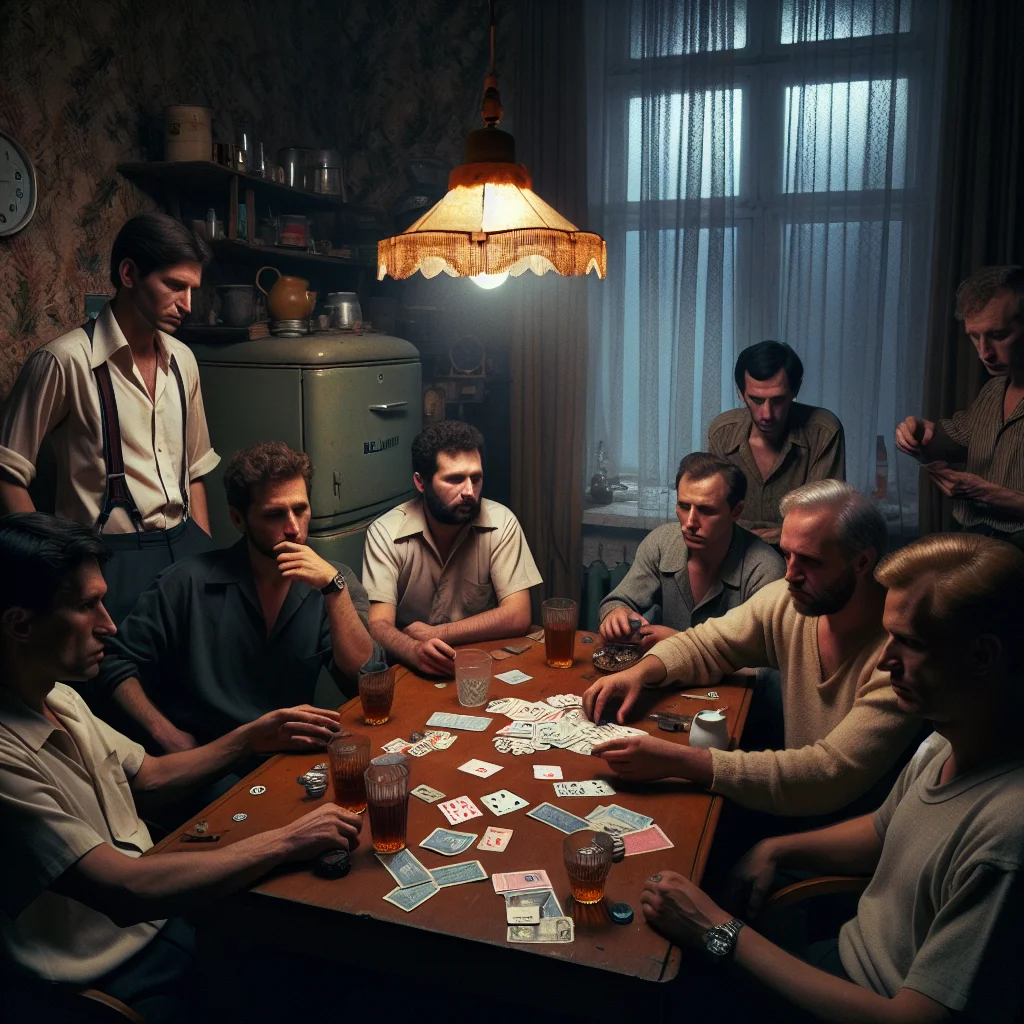
Far from the bright lights of official ceremonies, the real heart of Soviet gambling beat in cramped apartments, factory dormitories, and secluded dachas. Card games, particularly “preference” and “point,” were the kings of this shadow economy. These were not friendly games for matchsticks; they were serious, high-stakes affairs often involving substantial sums of money, which itself was an illegal act. The “kommersant” (black marketeer) who had access to scarce goods might sit across from a factory foreman or a university professor. These games were a great social equalizer under the blanket of secrecy. Organizing a game required meticulous operational security—trusted contacts, secure locations, and lookouts. The penalty for being caught could range from a severe reprimand at one’s workplace to criminal charges for “parasitism” or “speculation.” The atmosphere in these clandestine salons was thick with smoke from cheap cigarettes, the clinking of glasses filled with vodka or port wine, and the tense silence punctuated by the slap of cards on the table. This underground culture fostered its own codes of honor, debt enforcement mechanisms, and legends of legendary players who won and lost fortunes in a single night.
The Psychology of Risk in a Planned Economy
The prevalence of gambling in a society that outlawed private enterprise speaks volumes about the human desire for risk and reward. In an economy where career paths were largely predetermined and salaries were fixed and egalitarian, gambling offered a rare avenue for dramatic agency. It was one of the few arenas where an individual, through skill, luck, or sheer audacity, could alter their material circumstances overnight. This tapped into a deep-seated cultural narrative present in Russian folklore and literature—the idea of sudden, transformative luck. Furthermore, the constant deficits and the thriving black market (“blat”) normalized circumventing the system. If one needed to procure jeans or sausage, one learned to navigate unofficial channels. Gambling was simply another, more risky, unofficial channel for acquiring wealth. It also served as a social outlet and a test of character, a space for displaying “kulak” (fist)—a mix of shrewdness, nerve, and resilience highly valued in certain circles.
The Post-Soviet Explosion: From Shadows to Neon Lights
The collapse of the USSR in 1991 didn’t create a gambling culture; it unleashed it. Almost overnight, the underground river of gambling burst into a flash flood. The early 1990s were a period of chaotic transition, where the old rules were gone and new ones were yet to be written. This vacuum was quickly filled by a wave of often crude, makeshift casinos and gaming halls. They sprouted in hotel basements, former cinemas, and even converted shops, marked by flickering neon signs advertising “Kazino” or “Poker.” The clientele was a mix of the “noveaux riches” (the so-called “New Russians”), criminal elements, and ordinary citizens dizzy from economic shock therapy. The games were frequently rigged, security was provided by private “brigades,” and the line between business and organized crime was indistinguishable. This era was immortalized in popular culture, from songs to movies, depicting it as a time of dangerous, lawless opportunity where everything was for sale, and luck was the only constant in a world turned upside down.
Legal Battles and the Modern Landscape
The wild west period of Russian gambling was curtailed by a decisive government move in 2009. Following a model similar to one once used by the Soviet state, the Kremlin banned gambling establishments almost everywhere in the country, confining them to four specially designated zones. This recentralization of control was a stark reminder of the enduring state preference for regulating vice rather than eliminating it. Today, the landscape is a hybrid of the Soviet past and globalized present. State lotteries remain massively popular, a direct legacy of the Sportloto era. Meanwhile, the internet has created a new, borderless underground, accessible to anyone with a smartphone, echoing the secret home games of the Soviet period but on a colossal scale. The cultural imprint is deep: a generation that lived through the 90s retains a particular familiarity with risk, while the older generation might view lotteries with a sense of normalcy inherited from their socialist youth. The story of gambling from the USSR to today is not a simple tale of prohibition and liberation. It is a continuous thread, weaving through the fabric of society, adapting to each political and economic reality, always reflecting the eternal human dance with fortune and chance in a world where both are often in short supply.